
Oleoresin capsaicin: the suspicious, angry-looking red sauce that is the living embodiment of “curiosity killed the cat”. Why would I make such a concoction? I was curious. Why do people try the concoction? They’re curious. Sadly, the sauce has been banned from school grounds (and for good reason). However, thanks to the sacrifices from the many people who decided to try the suspicious sauce, I gathered a large range of data. Overall, drinking milk from the cafeteria or eating some form of bread (e.g. donuts) was the best observed way of suppressing the spice.

The oleoresin capsaicin extracted from the recipe I found could have been anywhere from 15 million to 10 million Scoville Heat Units (SHU); exact measurements are impossible without precise instruments, and taste-testing is not an instrument nor precise. Carolina reapers, the pepper that this capsaicin was extracted from (fig 1), have a hotness of 2.2 SHU. For comparison, cayenne peppers only have 30 thousand SHU, which means that the reaper peppers are around 73x spicier.
The method for extracting oleoresin capsaicin is relatively simple, as the desired product (capsaicin) is only 80% pure in the final step. Purification of capsaicin past that point requires toxic and inedible chemicals. The method I followed used 100% pure ethanol alcohol to dissolve the soluble capsaicinoid chemicals in the pepper.
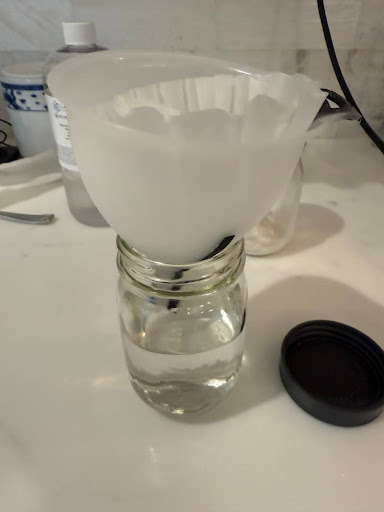
Firstly, because it is nigh impossible to buy dry ethanol alcohol, I acquired 95% food-grade ethanol and removed the water using anhydrous sodium sulfate, which binds to the water and can be filtered out. (fig 2)
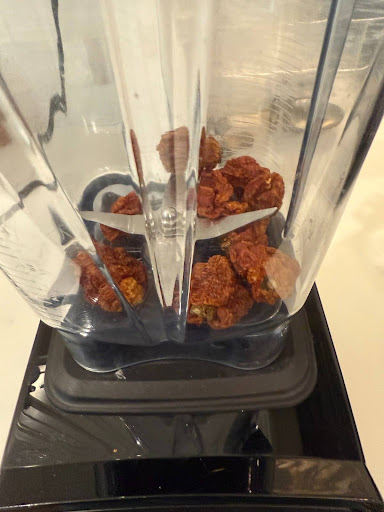
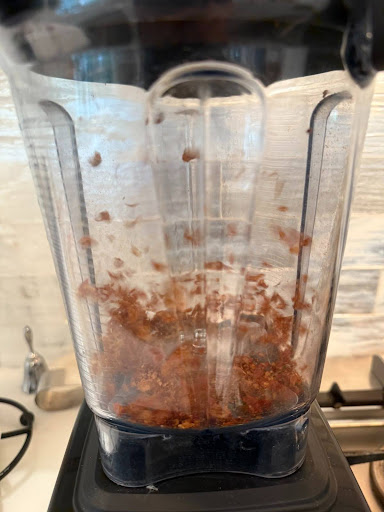
Next, I macerated the Carolina Reaper peppers to increase the peppers’ surface area, which would increase the rate of dissolution. (fig 3,4)
I then thoroughly mixed the macerated pepper and pure ethanol in a sealed container, which had already taken on an orange hue. (fig 5)
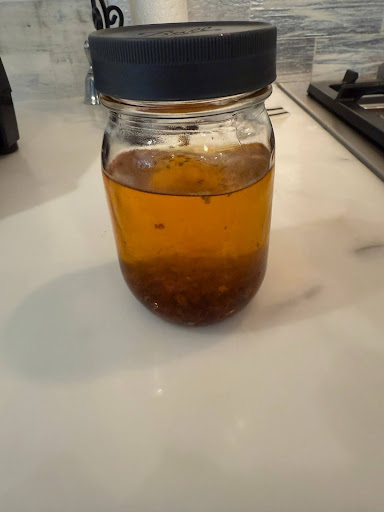
I then left it to sit on my countertop for a week, swirling the mixture once every day. By the end of the week, the mixture was a blood-red hue. (fig 6)
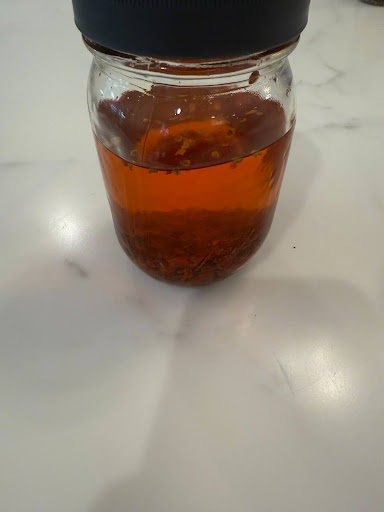
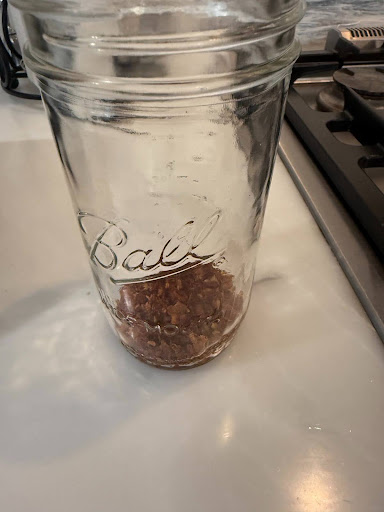
Afterwards, I filtered out the macerated pepper with a coffee filter. Some of the light-reflecting molecules had dissolved out into the ethanol, so the pepper left behind was paler than before. (fig 7)
Finally, I poured the reddish, scary-looking liquid into a glass tray and let it evaporate for a couple of days. Ethanol has a lower boiling point than water, so the evaporation process was relatively quick. What was left behind in the tray was an angry-looking, blood-red oil, which was the finished product! I tasted it with my brother, and we confirmed that it was indeed oleoresin capsaicin, and spent the next thirty minutes regretting our decision. I, in my everlasting genius, spilled a tiny amount of pepper-contaminated ethanol on my hand, and when it dried quickly, I thought nothing of it. Five hours later, I learned the virtues of lab safety the hard way when I rubbed my eyes.
Extracting capsaicin is no small feat, and tasting it isn’t either. However, making the precursor of pepper spray at home is so much more rewarding than buying capsaicin at the store.