

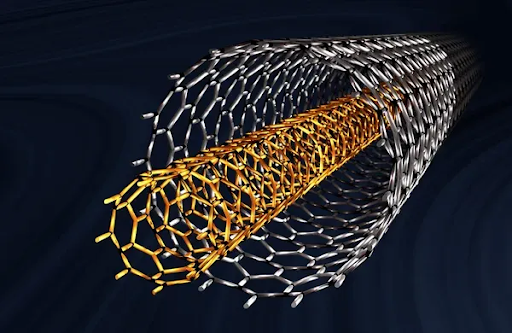
Introducing the Carbon Nanotube
A carbon nanotube (CNT) is essentially a rolled piece of graphene. Graphene is formed by a lattice of hexagonal carbon atoms, and this extremely stable structure is what brought it recognition as the strongest material on earth; its tensile strength—its ability to resist deformation—is approximately 200 times that of steel. Interestingly, graphene is also the best known electrical conductor.
The first CNT was multi-walled and synthesized in 1991 by Sumio Iijima, who passed a direct current through two graphite electrodes in a method known as arc discharge. Subsequent developments in 1993 by others from Iijima’s lab, Nippon Electrical Corporation, introduced metal catalysts during the production process to make it more efficient and give producers control over the number of walls created in a CNT. Accordingly, this advancement resulted in the creation of the first single-walled CNT. Around the same time, two new methods of CNT synthesis also emerged: laser ablation and chemical vapor deposition. These three mentioned methods remain the most popular and widely used today, having been very successfully used to mass produce CNTs. This very mass production was made feasible by the utilization of metals as catalysts, which allowed for better temperature control and more efficient synthesis1.
A Potential Carcinogen
In 2008, researchers noticed structural similarities between CNTs and asbestos; both materials are elastic and fiber-like. Due to the known carcinogenic properties of asbestos that result precisely from its structure, the researchers lined the abdominal cavities of rats with CNTs, mimicking the distribution of asbestos in the chest cavity of an asbestosis patient. The rats injected with long CNTs subsequently developed granulomas—lesions formed around the chest cavity—in a similar fashion to those exposed to long fibers of asbestos2. This similarity suggested that CNTs may also cause mesothelioma. However, a similar 2010 study found that although certain CNTs lead to the development of granulomas, the tested rats did not develop mesothelioma at all3. Due to the absence of human testing, scientists are only able to conclude that CNTs are potentially carcinogenic to humans. A newer 2017 study refines our understanding of possible dangers of CNTs by acknowledging the variability in behaviors of different CNTs; since there exist a vast multitude of CNT geometries, and only some of them have the potential to induce granulomas, scientists are unable to fully classify CNTs as either safe or dangerous4; however, as asbestos fibers are notoriously impossible to remove from the human body, there still exists a reason to take extreme caution against misuse of CNTs as a whole.
The most recent update to our understanding of CNT behavior is a 2024 study that used HepG2 cells—immortal human liver cancer cells—to stimulate an organic liver-like environment and observe effects of CNTs on these types of cells. The study tested a raw version of the multi-walled CNT and two chemically modified versions, and found that all three versions caused the liver cells to exhibit signs of cell damage, scarring, and lipid and cholesterol disruption, going beyond simple physical disruption5. Interestingly, the chemically modified CNTs actually caused more disruption than the raw version, suggesting that chemical modifications do not always increase safety.
The Correct Way to Use CNTs
Despite these concerns, CNTs possess a combination of properties that actually harmonize perfectly with what is currently needed in medicine; its thinness, strength, and chemical affinity allow it to penetrate cell membranes. Though this ability has been earlier stated to cause problems within the chest cavity, it can actually benefit medical professionals profoundly when harnessed correctly; CNTs may be used as drug delivery vehicles to inject them directly into cells, thereby negating the risk of premature absorption by the body6. CNTs also have another critical application in cancer research; they have a very high capacity for the absorbance of near-infrared light. When combined with their thinness, they are, in theory, able to specifically target and essentially burn away cancer cells7. The findings, if true, would revolutionize our methods of cancer treatment and significantly improve cancer therapies.
Currently, CNTs pose little risk to the general public, as they are contained within only a certain specialized field. In the future, however, as billions of dollars are invested into CNTs, stricter regulations may become necessary to ensure the safe use of CNTs and to prevent a repeat of the 20th century asbestos catastrophe.
Consulted Sources/Further Reading
- Hughes, K. J.; Iyer, K. A.; Bird, R. E.; Ivanov, J.; Banerjee, S.; Georges, G.; Zhou, Q. A. Review of Carbon Nanotube Research and Development: Materials and Emerging Applications. ACS Applied Nano Materials 2024, 7 (16). https://doi.org/10.1021/acsanm.4c02721.
- Poland, C. A.; Duffin, R.; Kinloch, I.; Maynard, A.; Wallace, W. A. H.; Seaton, A.; Stone, V.; Brown, S.; MacNee, W.; Donaldson, K. Carbon Nanotubes Introduced into the Abdominal Cavity of Mice Show Asbestos-like Pathogenicity in a Pilot Study. Nature Nanotechnology 2008, 3 (7), 423–428. https://doi.org/10.1038/nnano.2008.111.
- Varga, C.; Szendi, K. Carbon Nanotubes Induce Granulomas but Not Mesotheliomas. In Vivo 2010, 24 (2), 153–156.
- Kuempel, E. D.; Jaurand, M.-C.; Møller, P.; Morimoto, Y.; Kobayashi, N.; Pinkerton, K. E.; Sargent, L. M.; Vermeulen, R. C. H.; Fubini, B.; Kane, A. B. Evaluating the Mechanistic Evidence and Key Data Gaps in Assessing the Potential Carcinogenicity of Carbon Nanotubes and Nanofibers In Humans. Critical Reviews in Toxicology 2017, 47 (1), 1–58. https://doi.org/10.1080/10408444.2016.1206061.
- Thai, S.-F.; Jones, C. P.; Robinette, B. L.; Ren, H.; Vallanat, B.; Fisher, A.; Kitchin, K. T. Effects of Multi-Walled Carbon Nanotubes on Gene and MicroRNA Expression in Human Hepatocarcinoma HepG2 Cells. Materials Express 2024, 14 (3), 403–415. https://doi.org/10.1166/mex.2024.2641.
- He, H.; Pham-Huy, L. A.; Dramou, P.; Xiao, D.; Zuo, P.; Pham-Huy, C. Carbon Nanotubes: Applications in Pharmacy and Medicine. BioMed Research International 2013, 2013 (1), 578290. https://doi.org/10.1155/2013/578290.
- Khangar, P. K.; Daniel, V. Harnessing Multi-Walled Carbon Nanotubes to Overcome Cancer Resistance: Utility and Challenges. Research Journal of Pharmacy and Technology 2025, 18 (8), 4001–4006. https://doi.org/10.52711/0974-360x.2025.00575.