
The Era Before Friends Academy
Friends Academy was officially founded on April 17th, 1876, but the history surrounding its central figures and founding goes back much further. The story of Friends Academy began with Quakerism, which was brought to Long Island around the late 1650s by Quaker missionaries. This was followed by the arrival of George Fox, a key figure who quickly initiated the spread and establishment of Quaker principles in Long Island that would influence society for centuries to come. Quakerism didn’t spread without its controversies; however, despite advocating principles of peace and equality, Quakers were discriminated against across the East Coast and, because of this, struggled to form settlements in various places. Luckily for them, due to a lack of major settlements in Long Island, it was not too problematic for them to settle there.
Interestingly, the island wasn’t completely uninhabited. Dutch and English merchants had arrived before the Quakers and had been fighting with the local Lenape & Matinecock people for years, ultimately leading to the near eradication of the Matinecock people. The Quakers had sided with the natives, going back to their principles of pacifism and equality. They believed the Matinecock did not deserve the harsh treatment and discrimination they were facing. Therefore, they helped harbor members of the tribe during times of conflict and danger. This aid would mark just one of many times during which Quakers would positively impact a struggling group or population, and this impact is still apparent today. We would go on to name the town of Matinecock after these people and build the Matinecock Meeting House 300 years ago (1726). The establishment of both the town and the Meeting House would prove to be key points of Quaker history in Long Island.
The Founding of Friends Academy
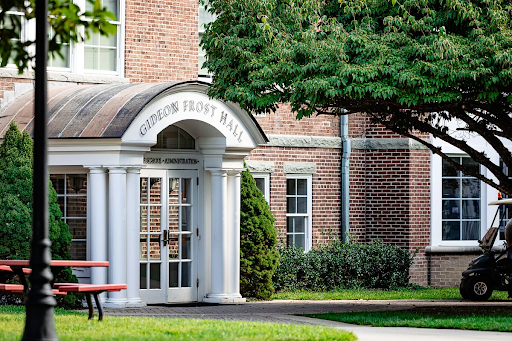
Quakerism would continue to expand its influence over the course of the next 150 years. Gideon Frost, a prominent Quaker figure in Long Island, bought the land near the Meeting House in 1875 and founded Friends Academy a year later. The school would officially open its doors in the following year, marking the official start of Long Island’s oldest continuously operating Quaker school. The class size started small but grew quickly with funding from the Frost family, amongst other influential Quaker families like the Underhills, the Jacksons, and the Dolans. Frost’s estate would continue funding the school’s development long after his death in 1880, just four years after he founded Friends Academy, allowing it to continue its expansion in the future.
The Growth of the School
By the early 1900s, the school had added new wings to the main building, converted an old barn into a gym, and built an infirmary. It was well on its way to becoming the pillar of Quakerism on Long Island that it is today. This growth continued into the Roaring 20’s; however, there were some bumps along the way. In 1922, the school’s laboratory actually caught fire because of issues with the heating system. Luckily, this incident didn’t stop the development of the school. The boys’ gymnasium was constructed shortly after, followed by a major property expansion and the introduction of college entrance exams at FA. The school faced more challenges at the end of the decade when the Great Depression began, followed ten years later by the Second World War. There was a lot of divide in the Quaker committee during this time, especially pertaining to their involvement in the war effort. However, progress persisted. The school built a west wing, a new kitchen wing, and started its Pre-Primary program.
A few years after the war, in the 50s, the school made its biggest changes yet: It built faculty apartments and a more modernized infirmary. It also shifted from a boarding school to a day school. The Quakers’ role as peacemakers especially shone through during the 1960s, a tumultuous era that saw the rise of the Cold War. The school also experienced some major renovations, the alumni development office was established, and a new learning center and library project was started. The school was starting to gain much attention, to the extent that in 1967, Robert F. Kennedy himself came to speak to students. In the 1970s, plans for a new science wing began, and the Underhill Building was newly repurposed as the Alumni Gym.
Friends Academy Today
In the past 20 years, Friends Academy has continued to be no stranger to progress. The school kicked off the start of the new millennium with the construction of the Kumar Wang Library in 2000. It was the first time students used computers in their education, signalling a major shift into the modern era of technology. Following the construction of the library, the school underwent many major renovations from 2000 to 2016, including the renovation of the Dolan Center, Kumar Wang Library, the gym/field house, and the Upper, Middle, and Lower Schools. Despite the multitude of changes that have occurred across the different eras of our school, its core principles have remained constant. We, as a school, value Simplicity, Peace, Integrity, Community, Equality, and Stewardship above all else.