

Do you know what can be recycled at Friends Academy? Sustainability at our school doesn’t only mean being aware of what we can do in our community, but it also means that, in the form of conversations, lunch and learns, and sharing, we can discuss how we can do it. Not only is it important for our school to have a more sustainable environment, but it is just as important, if not more, to pass on awareness to those entering the upper school and middle school. This can ensure that the messages sustainability delivers can be engraved in our school society. By educating and involving everyone, we can make sustainability a lasting part of our school’s culture.
The communal issue with sustainability at our school is that when there is some form of discussion on sustainability, the future steps of the lesson seem to be forgotten. To be more specific, I can use an example that most people know and fully understand: Recycling in the lunchroom. Most, if not all, students in the upper school understand why this exists here, but only a few of those students actually know what to recycle after meals, or more importantly, where the recycled materials go. This unawareness leads to people putting regular trash inside recycling bins, which leads to them being viewed as normal waste bins. Overall, this lack of knowledge ends up taking away the value of the recycling bin, making it seem as if it were never there.
There are several solutions to this problem that touch upon three categories: education and awareness, design, and responsibility.
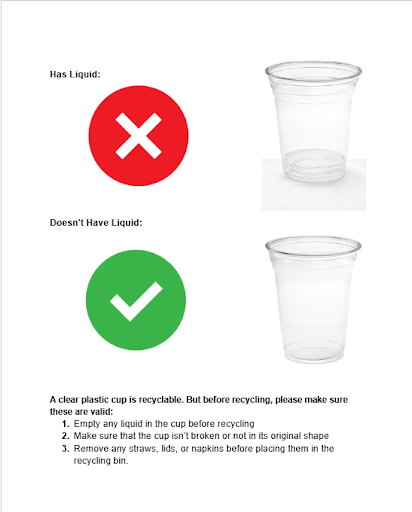
First, for awareness, a simple laminated sign can easily indicate what to put in the recycle bin and what not to put in the bin. This will help the initial problem of recycling in our lunchroom. An additional benefit to this is that these laminated signs are cheap, efficient, and easy to supply. We can easily print more than a dozen copies, order many lamination holders (shown in the image below), easily change what we would want to display, and effortlessly spread them across the lunch room.
Clear sign holder:

Possible template:
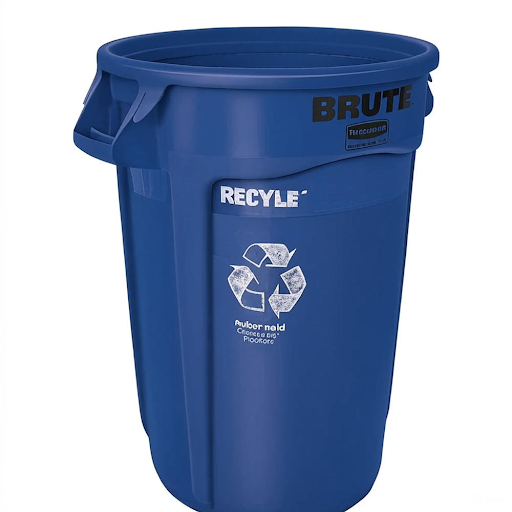
Next up is the design. While the present recycling symbol does give a very clear indication, a sticker could also be helpful. Another method relates to an experience I’ve had at lunch. In response to my experiences, having a color-coded bin would assist this. Yes, the bin color wouldn’t be noticeable when it is in its original position inside the stand, but during nearly every lunch for the past month, the bin has been brought out of its original position. This means that the indication would be helpful. For a specific color, based on the success of using the blue trash bins in classrooms, blue would be a helpful color. It also wouldn’t hurt to put another sticker on the bin.
Lastly, community. In the Upper School, the Monday assembly has always been an amazing way for updates to reach the entire student body. To go more in depth, committees, clubs, faculty, athletes, and students have all had a way to get their announcements out to the public. A specific example for the method I am about to explain connects back to the 2024-2025 school year. I remember when one of the teachers gave an update to the school on how we were doing with cleaning up after lunch. Sometimes the Upper School would get acknowledged for keeping it clean, and sometimes we would receive constructive feedback on how to keep it in better condition. Building off of this method, one or more sustainability committee members can check whenever the lunch staff empties the bins and take note of how good the recycling bins are kept. With this information, they can let the community know how they’re doing in Monday assembly. This will ensure that we not only use the recycling bins, but that we use them correctly.
Recycling as a whole community works best when the whole school participates. We shouldn’t just leave it to the staff or teachers to ensure a sustainable community. Through the use of teamwork and student-led cleanups after every lunch, we can ensure that we use the school bins correctly with the intention of sustainability. A chain reaction of students keeping each other in check will keep this sustainable intention alive for longer.
Sustainability isn’t only about recycling and fixing climate change; it’s also about translating every meeting and discussion into planned action in order to do good within our community. By teaching students and helping them understand what it means to have a better community, we can create a school culture where sustainable habits last. With the assistance of everyone, in the form of small actions, we can ensure a big impact on our environment. At Friends Academy, sustainability isn’t just some committee about the environment; it is an all-school, involved plan in making a better world.